Very often, after I’ve told a friend about a bleak sounding movie That They Just Must See, they ask, “don’t you ever go to the movies to escape”? My answer is prompt. Yes. Always. Especially these days, where events in the real world, on a daily basis, are so relentlessly despairing. I don’t go to the movies to dutifully eat my vegetables, or, worst of all, to be lectured to. Yuck. I go to the movies to be thrilled.
The thing is, however, my definition of “thrills” and “escapism” is somewhat different than the Hollywood definition. Show me a pretty boy movie star, an Uzi in his left hand, clinging to a rope with his right, mowing down a score of bad guys while rappelling from a flaming helicopter into a speeding aircraft with a mortally wounded pilot, and I will not have escaped. I will be bored.
Whereas, something like this, described but unseen, from My Dinner with Andre: André was leaning against a crumbling old building and sobbing. He’d just been watching the Ingmar Bergman movie Autumn Sonata and was seized by a fit of ungovernable crying when the character played by Ingrid Bergman said “I could always live in my art, but never in my life.” Well, now you’ve got me.
Suffering for one’s art is one of my favorite genres. And it is pure escapism. It does not well describe the mundanities of my day to day life, and it is, in many ways, a luxury product, far beyond my reach. So just as many people enjoy ogling the lifestyles of the rich and famous, I get a vicarious thrill from watching gifted people suffer for their art.
Here are ten of my favorites from this marvelously escapist genre. It is not exhaustive.
After the Rehearsal This late-career chamber piece by Ingmar Bergman considers a legendary theater director as he prepares to stage August Strindberg’s A Dream Play. Bergman, who had staged this production numerous times, is represented here by his oft alter-ego Erland Josephson. In the words of Roger Ebert: “we are left with at the end . . . [with] the very strong sense of an artist who has sacrificed many lives for the sake of his art, and now wonders if perhaps one of those lives was his own.”
All That Jazz We recently discussed this one on That ‘70s Movie Podcast, where I’m pretty sure I said that this semi-autobiographical film by Bob Fosse was perhaps the greatest movie ever made about the artistic process. I think that’s probably right. It’s also a masterpiece, with an astonishing performance by Roy Scheider, standing in for Fosse.
Camera Buff This early feature from Polish grandmaster and MCC favorite Krzysztof Kieslowski shows the process of falling in love with making movies—here quite by accident. Kieslowski regular Jerzy Stuhr plays a family man who buys a simple camera in anticipation of making some home movies, and finds, like François Truffaut before him, that it becomes increasingly difficult to distinguish between (what becomes) his art and his life. At one pivotal moment, in the midst of an intense marital row, he can’t help imagining what his wife would look like “playing their scene” through an imagined viewfinder. She was not amused.
Day For Night Speaking of Truffaut, this 1973 charmer (Godard hated it for exactly that reason), is, at this moment, my favorite movie about the making of a movie. Haunted in his dreams by the grand achievements of Orson Welles and Ingmar Bergman, the director of the likely ill-fated “Meet Pamela” – who is played by, um, François Truffaut – shares this representative thought: “Making a film is like a stagecoach ride in the old west. When you start, you are hoping for a pleasant trip. By the halfway point, you just hope to survive.” An absolute delight, with one of Jacqueline Bisset’s greatest performances.
Life Lessons Martin Scorsese’s contribution to the otherwise forgettable New York Stories omnibus clocks in at forty-four minutes—but holds a place as one of my favorite Scorsese pictures (that is sky-high praise, not a passive aggressive dig). Very loosely based on Dostoyevsky’s novella The Gambler, Life Lessons captures the impossible artist in all his glory: difficult, insecure, charismatic, manipulative, and brilliant. Nick Nolte, outstanding, plays a painter facing a crisis of confidence and a ruinous private life, and inhabits a character not dissimilar from Joe Gideon (Scheider) in All that Jazz.
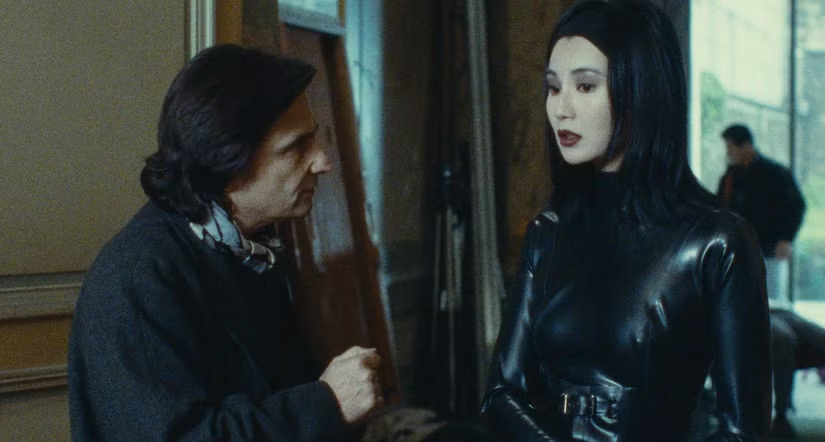
Irma Vep Oliver Assayas’ 1996 film is something of an updated reimagination of Day for Night, with Jean-Pierre Léaud (who appeared in Truffaut’s film), now stepping into the shoes of the “director struggling with a troubled production”—although in this instance, the director is a big part of the problem. With Maggie Cheung and a party of favorites, Jonathan Rosenbaum lauds the film as an “unexpected masterpiece” whose “subject isn’t ‘cinema’ but cinema as a battleground, a treacherous terrain where power struggles are constantly waged.” But it’s also enormous fun—so much fun Assayas revisited the project with an absolutely irresistible six part mini-series in 2022.
Opening Night OK, maybe it’s a wee bit of a stretch to call this one “escapism”—but let’s keep in mind that John Cassavetes liked to say “I wouldn’t call my movies . . . entertainment.” But oh, my, Gena Rowlands as an actor on the brink is quite special, as are the supporting performances by Mr. Ben Gazzara, Cassavetes, as well as Paul Stewart and Joan Blondell. Opening Night can be followed by Pedro Almodóvar’s most excellent All About My Mother, which it influenced, and Cassavetes’ own The Killing of a Chinese Bookie whose nominal plot is a metaphor for every struggling artist crushed by the studio suits that has ever been.
The Other Side of the Wind Orson Welles’ final film is necessarily a compromised one. It was assembled as faithfully as possible, but nevertheless completed decades after Welles had left us. Thus in both text (the movie is about the seventieth birthday of a legendary, and legendarily difficult filmmaker) and subtext (endless legal battles left this release to fall some forty years after the completion of principal photography), this is a film that embodies the artistic struggle. The trailer is quite something, but the whole movie should be seen—if only for John Huston, here with his greatest on-screen work. That we do not have a box set of this film, an attendant documentary, and various additional materials, is a scandal.
Stardust Memories Woody Allen’s director-in-distress entry sharply divided critics upon its release. Coming on the heels of popular triumphs (and outstanding achievements) Annie Hall and Manhattan, which garnered the writer-director widespread critical acclaim, many saw Stardust as gratuitously biting all those hands. (Woody seemed to notice this, as his next few films were more user-friendly.) Others compared the movie unfavorably with Fellini’s 8½, an obvious inspiration. But Stardust holds up well today: beautifully shot, prescient about the pathologies of celebrity culture, and very effective in juggling its fractured time hall-of-mirrors movie within a memory within a movie.
Vanya on 42nd Street Having opened with Andre, let us close with Andre – Andre Gregory, that is, the real person, who seems to live in that space where art and life intersect. Vanya has its origins in his commitment to experimental theater: he workshopped Chekhov’s Uncle Vanya for years in an abandoned, decrepit midtown theater with a cohort of collaborators, old and new, including Wally (Wallace Shawn), Julianne Moore and Larry Pine. Eventually Louis Malle shot a version of the production-in-endless-process. Try this one as a double feature with Ryûsuke Hamaguchi’s wonderful Drive My Car, which is also steeped in Vanya—and in a similar exploration.